
Amid Aspen Fairs, Collectors Peruse Big-Ticket Art, Private Jets, $62.5M House
Long before Aspen belonged to billionaires, it belonged to one millionaire’s imagination.Chicago industrialist Walter Paepcke arrived in Aspen after t...
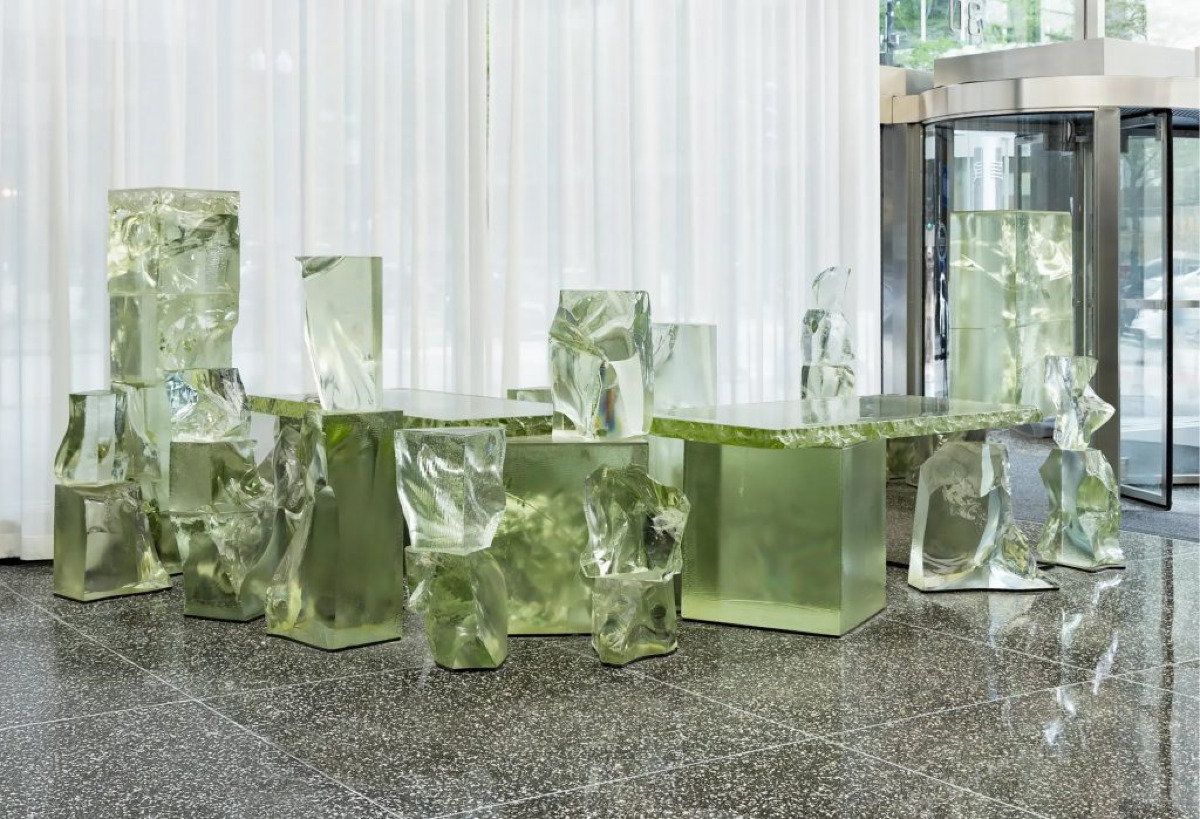
Reception desks don’t often make auction history. But one designed by Frank Gehry just set an auction record for one of the late architect’s design objects.
Colloquially known as Icehenge, the work brought in $243,200 at Chicago-based auction house Freeman’s last week, surpassing its high estimate of $200,000. Its new owner is receiving quite the behemoth: a 16-piece, seven-ton glass installation that Gehry created for the lobby of the Inland Steel Building in Chicago.
“Although we knew it might be a difficult object to place due to its size and heft, buyers from a variety of backgrounds and locations turned out in force,” Roger Ward, Freeman’s vice president of design, said in a statement. “The buyer is also dedicated to maintaining public access to Icehenge and is considering a temporary loan to a suitable museum or institution.”

Detail of Frank Gehry, Icehenge desk (2012). Photo courtesy of Freeman’s.
Gehry had long admired the Inland Steel Building, designed by architects Skidmore, Owings & Merrill in the 1950s. Among other things, he was drawn to its stainless steel facade—an influence that would echo in his design for the Guggenheim Bilbao (1997). Gehry acquired a stake in the 19-story skyscraper in 2005 to help oversee its refurbishment, eventually selling it off some years later.
Sign up for our daily newsletter.
As part of the renovation, Gehry created Icehenge, a composition of rough-cut glass blocks mottled with internal bubbles and distortions. Two large slabs serve as work surfaces, while myriad standing forms and columns surround the desks.
The idea for the work grew from a single fragment of glass Gehry encountered while working on another project. By stacking the blocks at shifting angles, he could create dramatic refractions, drawing attention to their textural imperfections. The glass was further tinted green to mirror the building’s windows.

Frank Gehry, Icehenge desk (2012), installed in the Inland Steel Building lobby. Photo courtesy of Freeman’s.
When Icehenge was completed by John Lewis Glass Studio, this play of light was immediately apparent. Installed in the building’s modernist lobby, it offered a weighty counterpoint to Richard Lippold’s geometric sculpture, Radiant 1 (1956). Gehry had a more colorful description for it, though.
“It does look like an explosion in a glass factory, kind of,” he told the Chicago Tribune in 2013. “If you actually had an explosion at a glass factory, apart from everyone getting killed, it would be pretty exciting visually.”
Icehenge dethroned one of Gehry’s whimsical Fish Lamps, which sold for $239,400 at Phillips New York in 2021, as his most valuable design object at auction. His overall auction record remains the Winton Guest House (1987), which was sold via Wright for $905,000 in 2015, according to the Artnet Price Database.
Correction (July 22, 2026): An earlier version of this article misstated the presale estimate on the desk. Its high estimate was $200,000, not $20,000. This article has been updated.
Long before Aspen belonged to billionaires, it belonged to one millionaire’s imagination.Chicago industrialist Walter Paepcke arrived in Aspen after t...
Track live auctions, place bids in real time, receive outbid alerts, and manage your watchlist — all from your pocket.